


SOLARWEAVE

WHO WE ARE AND WHAT WE DO
OUR STORY
SolarWeave started with us, a group of students who shared a concern about rising energy costs and the lack of accessible renewable energy, especially for people living in cities. Coming from different interests in science, design, and sustainability, we found common ground in our school laboratory, where conversations about climate change and energy inequality quickly turned into hands-on experimentation.
Realising that most renewable solutions were rigid, expensive, and designed for homeowners rather than renters, students, or urban families like those around us, we were inspired to rethink where clean energy could come from. By combining our skills and working closely with teachers and industry mentors, we began developing photovoltaic textiles that could generate power while remaining flexible and practical.
What began as a classroom project evolved into a shared mission: to weave clean energy into everyday materials and make renewable power more inclusive. SolarWeave is the result of collaboration, curiosity, and the belief that sustainable energy should fit into people’s lives, not the other way around.

Manraj Tagar
.jpeg)
Sayujya Sanadhya

Andrey Pichugov


THE PRODUCT
SolarWeave is a fabric-like photovoltaic textile laminate that transforms everyday materials into active energy-producing surfaces. By embedding solar capability directly into textiles, it removes the need for bulky panels, permanent installations, or specialist infrastructure, making clean energy practical, portable, and seamlessly integrated into daily life.
SolarWeave is available in two forms, each designed for different applications. Type 1 prioritises efficiency and higher power output, making it ideal for more static uses such as furnishings, architectural textiles, and interior spaces. Type 2 prioritises flexibility and softness, making it suited to moving and portable products such as tents, parasols, backpacks, wearables, and other outdoor equipment. This dual approach allows SolarWeave to adapt to a wide range of uses without compromising comfort or design.
From homes and public spaces to campsites and outdoor settings, SolarWeave can be incorporated almost anywhere. No plugs, no permanent installations, just power where it is needed.
What really sets us apart, though, is our ability to turn ordinary fabrics into functional energy solutions. By weaving renewable power into the materials that surround us, SolarWeave reduces reliance on fossil fuels, expands access to sustainable energy, and brings clean power closer to everyday life.

HOW IT WORKS
SolarWeave is built as a layered textile laminate. From the outside in, it consists of a light-permeable fabric layer for durability and comfort, a thin waterproof barrier, a layer of integrated solar cells, a second waterproof layer for protection, and a final fabric backing. This structure allows the textile to remain flexible, durable, and weather-resistant, safely enclosing the photovoltaic components.
In our efficiency-centred variant, ultra-thin P-N junction silicon-based cells are what are used. However, for our hyperflexible variant, the energy generation comes from dye-sensitised solar cells (DSSCs). Each DSSC is made up of several thin layers: a porous titanium dioxide layer coated with a light-absorbing dye, a layer of electrolyte electrolyte, and a carbon-based counter electrode. When light hits the textile, electrons in the dye gain energy and move through the titanium dioxide, forming a current. Meanwhile, the electrolyte continuously regenerates the dye's electrons through an oxidation-reduction reaction. This layered DSSC design enables reliable power generation even in low and diffuse light, making it ideal for textile-based applications.
Power, however, is useless without ways to transport and store it. Thankfully, our specially-designed modular clip-on battery packs can be easily attached and removed from any side of the textile, delivering steady power output whenever you need it. Wiring the cells in parallel also means that even if one breaks, the array will still continue to function, and will be easily repairable.
.png)
MARKETING STRATEGY
As we operate as a B2B-focused company, our marketing strategy centres around building strong partnerships and long-term relationships with other businesses, rather than direct consumer advertising. We will initially collaborate with environmentally focused companies and outdoor brands that actively seek sustainable, innovative materials, who are open to piloting new technologies. These early partnerships will allow us to showcase our textile in real products, building credibility, performance data, and a strong portfolio of use cases.
As our technology matures and our portfolio grows, we will expand outreach to larger, more established brands and manufacturers, using proven pilot projects and case studies to demonstrate reliability, scalability, and commercial value. This staged approach reduces the risk of adopting our technology for partners, while building towards positioning SolarWeave as a trusted materials supplier in the long term.
In parallel, we will build public traction through influencers and creators focused on sustainability, design, and ethical consumer goods. While we do not sell directly to consumers, this visibility will increase demand from end users, strengthening the value we could bring to our B2B partners by demonstrating market interest in solar-integrated textiles, encouraging more brands to work with us.

HOW WE OPERATE
SolarWeave positions itself as a materials supplier, rather than a consumer brand. Instead of making end products ourselves, we partner with established businesses to integrate our solar textiles directly into their designs. This approach allows us to scale quickly while working with companies that already understand their markets and customers.
We aim to sell our fabric by the square metre to a wide range of partners, including outdoor and camping brands, interior designers and architectural studios, furniture and homeware companies, and wearable-tech and lifestyle brands. These partners could then use SolarWeave as a core material in products such as tents, curtains, blinds, bags, furnishings, and other textile-based designs.
Our strategy is built around B2B sales, long-term supply agreements, and co-development partnerships. By working closely with designers and manufacturers, we ensure SolarWeave fits seamlessly into existing production processes while adding unique functionality and value. In some cases, we also aim to license our technology for specific product lines, enabling deeper collaboration and faster adoption.
By focusing on what we do best, developing our photovoltaic textiles, SolarWeave empowers other brands to bring clean, integrated energy solutions to market. This model keeps SolarWeave flexible, scalable, and embedded across multiple industries, helping renewable energy reach more people through the products they already use.
.png)
REVENUE BREAKDOWN
The table to the left outlines our cost structure and price points for our products, including units of both product types. It highlights how production costs decrease with volume while maintaining strong margins, demonstrating the commercial viability of SolarWeave through mass production and long-term supply contracts.
TARGET SUPPLY PRICES
We aim to source lightweight fabric at £2.50 per m², PET or TPU encapsulation film at £1.50 per m², flexible thin-silicon photovoltaic material at £15.00 per m² (for Type 1), and DSSC photovoltaic material at £8.00 per m² (for Type 2). Manufacturing, lamination, and quality control are targeted at £3.00 per m² through the use of automated processes.
OTHER COSTS
In addition to production expenses, we will likely need a space for storage and work. In the beginning, we plan to operate from flexible co-working spaces such as WeWork, minimising costs while building partnerships. As the company scales, we intend to move into a roughly 50 m² combined warehouse and office space on the outskirts of London, suitable for storage, quality checks, and admin work. Using typical commercial rates in the area, we estimate an annual rent of approximately £18-25,000. This approach balances affordability with practicality, supporting efficient and scalable operations.
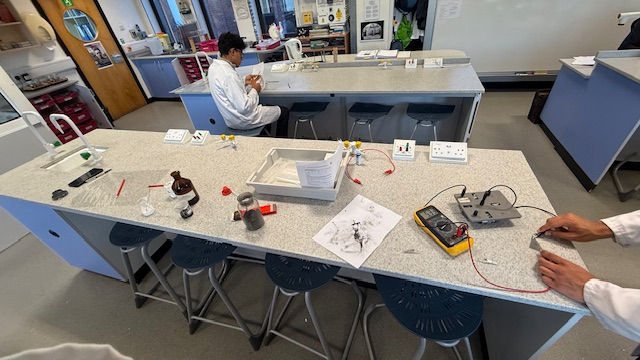
PROTOTYPE TESTING


SPECIFICATIONS (ENERGY OUTPUT)
.png)

The Future at SolarWeave:
At SolarWeave, we promise to forever redesign the global energy industry. As reliance on fossil fuels and nuclear energy is dropping, we are in desperate need for drastic change, and such change requires never-before seen solutions!
Below is the plan checklist for SolarWeave:
- plan + pitch + coordinate business ideas (done)
- successfully launch the business (done)
- conduct a proof-of-concept experiment (done)
- create a working proof-of-concept mini-prototype (done)
- connect/collaborate with textile businesses/experts to help put SolarWeave on the map (in progress)
- funding from brands/providers to enable production and research (to do)
- create first scalable prototype to show businesses in interest (to do)
- connect with lab/s to aid in small-scale production, then larger scale (to do)
- begin employment + paying wages (to do)
- begin to produce on larger scales and sell to small companies (to do)
- open SolarWeave HQ (to do)
- expand across the world to employ and ship (to do)
- become a leading company in the energy industry (final goal)